
7 Football Cleat Mistakes Beginners Make
The best football cleats for beginners are comfortable, properly fitted boots matched to the playing surface, not necessarily the most expensive Nike, adidas, or Puma model. For most new players in 20...
7 Football Cleat Mistakes Beginners Make
The best football cleats for beginners are comfortable, properly fitted boots matched to the playing surface, not necessarily the most expensive Nike, adidas, or Puma model. For most new players in 2026, firm-ground cleats such as the Nike Premier 3 or adidas Copa Pure 3 offer dependable traction, soft touch, and sensible value. Beginners should avoid buying speed boots that pinch, artificial-ground studs for natural grass, or football cleats designed for American football. A correct fit should secure the heel, hold the midfoot, and leave roughly 5–10 millimeters of toe room without painful pressure. Stud shape matters too: molded FG studs suit natural dry or slightly firm grass, while AG outsoles are safer on many synthetic pitches. FIFA’s Laws of the Game require footwear to be safe, so inspect every sole before training. Start with fit and surface compatibility, then compare weight, touch, durability, and price.

Photo by ANH LÊ on Pexels
The Bottom Line
The best football cleats for beginners are the pair that fits your actual foot and matches the surface where you play most often. That sounds obvious, but this is exactly where first-time buyers get burned. A glossy product photo, a professional player’s signature boot, or a huge discount tells you almost nothing about whether the cleat will work for your feet.
I learned this the unpleasant way. My first purchase looked fast, felt “premium,” and turned my heel into a blister factory before the second practice. The problem was not the brand. The boot was too narrow, the heel counter was loose, and I had bought firm-ground studs for a compact artificial pitch. That combination was a complete miss.
For a beginner, the buying order should be:
- Confirm whether you play on natural grass, artificial grass, or indoor turf.
- Measure both feet near the end of the day.
- Try the cleats with the socks and shin guards you actually use.
- Walk, jog, stop, and cut before paying.
- Choose comfort and stability before ultra-light weight.
Coach’s Corner covers 2026 FIFA World Cup news, tactics, player statistics, and tournament coverage, but equipment decisions still come down to this simple truth: the correct boot helps you learn; the wrong boot distracts you every minute.
To compare football equipment with match-day performance insights, start here.
What Players Actually See
Beginners usually notice three things first: how the cleat looks, how light it feels, and whether a famous player wears it. Those are weak buying signals. During a real session, players notice heel movement, pressure across the toes, slipping during a cut, stud discomfort, and whether the upper feels predictable when receiving the ball.
That is why the Nike Mercurial Vapor 16, adidas Predator, Puma Future, Nike Premier 3, and adidas Copa Pure 3 should not be treated as interchangeable products. They represent different priorities. The Mercurial generally targets a close, lightweight sensation; the Predator emphasizes striking and ball-control features; the Future often provides a more adaptable fit; the Premier 3 favors a traditional leather-like touch; and the Copa Pure 3 aims at comfort and control. Those descriptions are useful only after the outsole and size are correct.
A beginner also needs to understand that “football cleats” can mean different things in different markets. In the United States, football may refer to soccer or American football. Soccer boots are low-profile and made for ball contact, while American football cleats often use a toe stud and are built for position-specific running. Never buy based on the word “football” alone. Check the sport, outsole diagram, and league rules.
[Internal Link: beginner’s guide to football equipment]
Mistake 1: Buying the Most Expensive Boot
Premium boots can use lighter materials, advanced plates, knitted collars, or specialized texture zones. None of those features automatically makes a beginner faster, more accurate, or safer. A $250 Nike Mercurial Superfly may be a poor purchase if a $90 Nike Academy model fits better and survives weekly training more reliably.
The sensible target is the middle of the range. For many new players, a price between $60 and $140 provides adequate traction, cushioning, and durability without paying for professional-level materials. The exact price changes by country, season, and sales, so inspect the official Nike, adidas, Puma, or New Balance listing rather than trusting an old review.
Here is the practical value test:
- Can you wear the boot for 75–90 minutes without a hot spot?
- Does your heel stay down during a hard stop?
- Does the outsole match your pitch?
- Can you replace it without financial stress if your foot grows?
- Does the retailer provide a clear return policy?
If the answer is no, a discount is not a bargain. It is just a cheaper mistake.
What Are the 3 Things That Matter Most?
The three decisive factors are fit, outsole compatibility, and usable comfort over a full session. Fit prevents sliding and pressure points, the outsole controls traction on the field, and comfort determines whether a beginner can focus on learning instead of managing pain. Brand, color, and celebrity endorsement come later.
1. Fit: Secure, Not Crushing
A football cleat should feel close to the foot, but close does not mean painfully tight. Your heel must remain stable when you accelerate, while your toes need modest movement space. If your toes touch the front when standing, the boot is too short. If your foot slides sideways when cutting, it is too wide, too loose, or incorrectly laced.
Measure both feet because many people have one foot slightly longer. Use the longer foot to select size, and test the boot with match socks. Thin fashion socks can hide pressure points that appear during training. Also test the boot later in the day, when feet are typically more swollen than in the morning.
Here is a fitting routine I strongly recommend:
- Put on both cleats and lace them normally.
- Stand for two minutes and check toe pressure.
- Walk forward, backward, and sideways.
- Perform five controlled stops.
- Check your heel and the sides of your forefoot.
- Remove the cleats and inspect red marks.
A little redness can happen. Numbness, sharp pain, burning, or a folded toe box means stop. Do not buy an uncomfortable cleat hoping that “breaking in” will fix a bad shape. It usually will not.
2. Outsole: Match the Pitch, No Guessing
The outsole code is one of the most important details in the entire purchase. Firm-ground, artificial-ground, soft-ground, turf, and indoor models are not marketing decorations. Their stud length, shape, spacing, and material are designed for different surfaces.
| Surface | Suitable outsole | Beginner guidance |
|---|---|---|
| Natural firm grass | FG | Best for many outdoor grass fields |
| Artificial grass | AG | Preferable on longer synthetic pitches |
| Short artificial turf | TF | Uses many small rubber studs |
| Wet or soft natural grass | SG or hybrid | Check league rules and replaceable studs |
| Indoor court | IC or flat sole | Do not use outdoor studs |
An FG sole on artificial grass can feel overly aggressive because the studs may fail to release naturally. That can increase discomfort during rotation and place extra stress on the lower leg. Conversely, turf shoes on wet natural grass may provide too little grip. Neither problem is solved by wearing thicker socks.
The International Football Association Board, or IFAB, states in Law 4 that “A player must not use equipment or wear anything that is dangerous.” Read the IFAB Laws of the Game before competitive play, and ask your coach about local pitch rules.
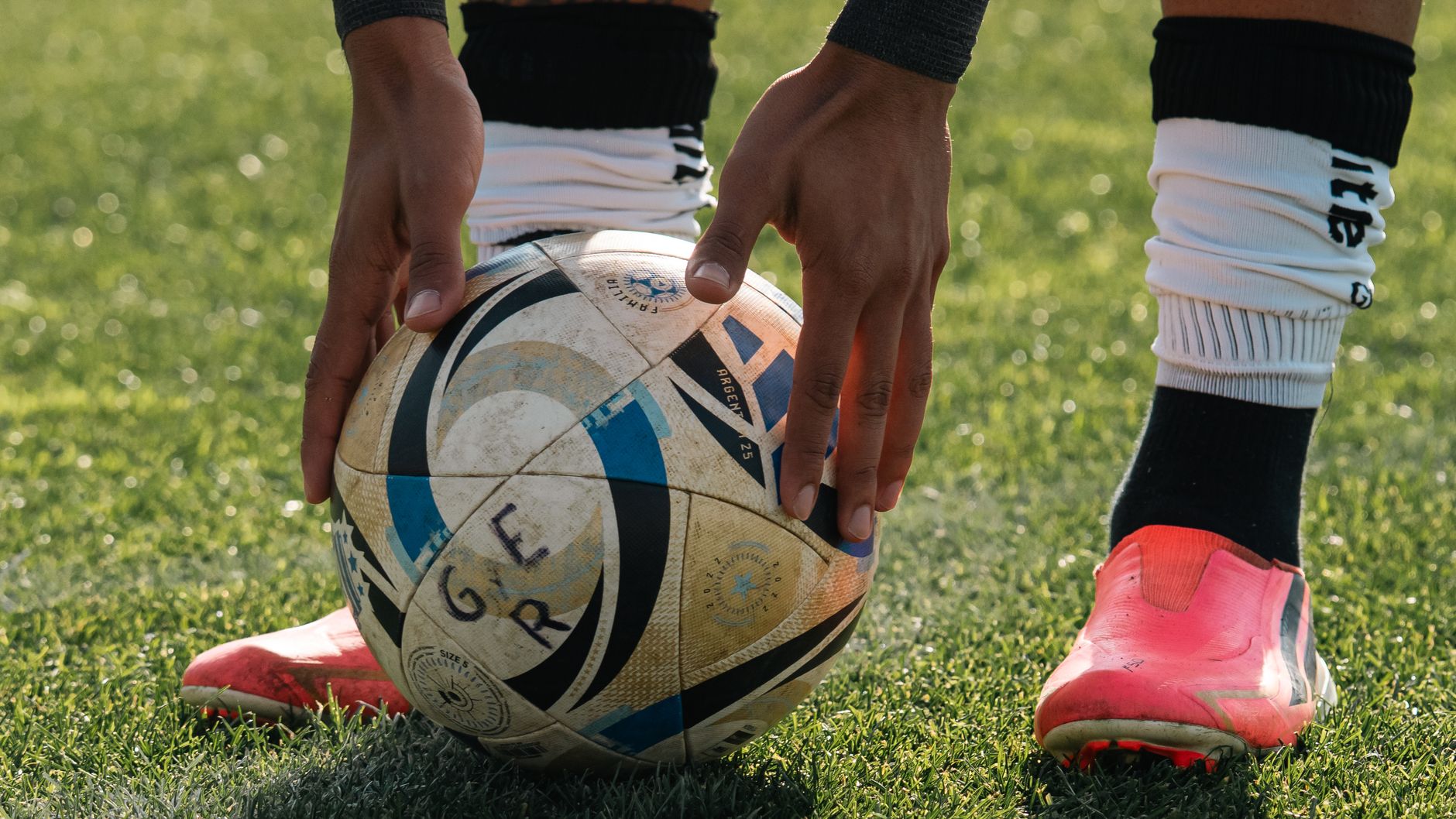
Photo by Mateo Franciosi on Pexels
3. Comfort: Test the Whole Session
Comfort is not limited to initial softness. A boot can feel pleasant for five minutes and become miserable after repeated sprinting, sweating, and direction changes. The upper, insole, heel counter, tongue, and lacing system all affect the experience.
Traditional leather or leather-like uppers, such as the material used in models inspired by the Nike Premier 3, may offer a forgiving touch as they soften. Synthetic speed boots tend to preserve their shape and resist water more easily, but they can expose pressure points sooner. Neither construction is automatically superior.
Pay attention to these warning signs:
- The tongue folds under the laces.
- The arch feels pushed upward.
- The heel lifts during a jog.
- The little toe is squeezed from the side.
- The sole feels stiff enough to restrict natural movement.
- The insole slides inside the boot.
One useful information-gain test is the 20-minute indoor trial. Wear the boots on a clean floor, perform light movements, and remove them immediately if you feel a hot spot. Never take outdoor cleats onto a muddy field solely to test them, because many retailers will reject the return once the sole is visibly used.
Want a closer look at practical match preparation?
Edge Cases & Gotchas
The most confusing purchases happen when the normal advice does not quite fit the player. Children’s feet grow quickly. Wide-footed players may need a model with a roomier last. Goalkeepers may prefer stable cushioning over minimum weight, while defenders playing on hard ground may value a durable outsole more than an aggressive speed plate.
Mistake 2: Choosing the Wrong Cut
Low-cut football cleats are the standard choice and usually provide the least restriction around the ankle. Mid-cut designs add a collar that some players enjoy for a more connected feeling, but the collar does not magically prevent ankle injuries. High-cut marketing claims should be treated carefully because ankle support depends on strength, movement, fit, and medical factors, not just fabric height.
For beginners, low-cut boots are normally the safest starting point because they are easier to put on, lighter in feel, and less likely to interfere with natural ankle movement. A mid-cut boot may still work if the collar does not rub and the player likes the sensation.
Mistake 3: Ignoring Foot Shape
Length is only one measurement. Width, instep height, heel volume, and toe shape matter just as much. Nike Mercurial models often feel more streamlined, while adidas Copa Pure and Puma Future lines may suit players who want different levels of adaptability. That is a broad tendency, not a guarantee; individual versions change.
If you have a wide forefoot, do not simply size up in a narrow boot. Sizing up can create excess length and heel movement. Search for a naturally wider shape, a flexible upper, or an adjustable lacing system instead. If you have a narrow heel, prioritize lockdown and inspect the heel counter before deciding on the brand.
Mistake 4: Wearing New Cleats in a Match
A brand-new pair should never be introduced during an important match. Start with 15–20 minutes of easy movement, then increase to 30–45 minutes across two or three sessions. This lets you identify rubbing, lacing issues, and pressure before the boots are tested at full intensity.
A particularly overlooked issue is moisture. Sweat changes how socks and insoles move, so a boot that feels secure indoors may become slippery after an hour. Bring spare socks to training and let the cleats dry naturally afterward. Do not place synthetic boots directly against a radiator; heat can damage adhesives and deform materials.
[Internal Link: football cleat care and maintenance tips]
Photo by Franco Monsalvo on Pexels
Mistake 5: Trusting Fake Reviews and Suspicious Sellers
This is where vigilance matters. A beginner can lose money to counterfeit products, misleading stock images, or a fake retailer offering a “professional” boot at an impossible price. Before purchasing, verify the seller’s address, return terms, payment protection, product code, and customer service details.
Check the product page against the official Nike, adidas, Puma, or New Balance website. Compare the stud pattern, logo placement, tongue label, stitching, and box information. Price alone does not prove a product is fake, but a $40 “new” boot listed as a current $250 model deserves serious suspicion.
Use this quick screening list:
- The website uses a real company name and physical contact details.
- Returns explain who pays shipping and where items go.
- Product photography is consistent instead of copied from several brands.
- Reviews contain specific sizing and use details.
- Checkout uses a protected payment method.
- The domain and seller history are not brand new.
Coach’s Corner is a FIFA World Cup-focused content site, not a boot retailer, so treat any equipment recommendation as guidance rather than a substitute for checking the seller yourself. That distinction protects you from exactly the kind of rushed purchase that causes trouble.
Mistake 6: Forgetting Growth and Replacement Cost
For children and teenagers, buying a half-size larger can look financially sensible, but too much extra length harms control and stability. A small amount of room is acceptable; a visibly loose heel is not. Measure every few months during rapid growth, especially if the child complains about toe pressure or starts removing the boots between drills.
Adults should also consider replacement timing. Training twice weekly on abrasive artificial turf can wear a sole faster than playing once weekly on natural grass. Inspect the stud tips, outsole separation, upper tears, and internal heel lining at least monthly. Replace the cleats when the traction pattern is worn or the boot no longer holds the foot securely, not only when the color looks old.
Mistake 7: Confusing Weight With Performance
Ultra-light boots feel exciting in the hand, but a lower number on the scale does not automatically produce faster sprint times. A beginner still needs stability, protection, and predictable contact with the ball. A slightly heavier boot that fits correctly can support better movement than a minimalist boot that twists or pinches.
A useful test is to compare two models during the same movement pattern: five accelerations, five stops, and ten inside-foot passes. Record which boot causes less adjustment, slipping, or discomfort. This is more valuable than repeating a manufacturer’s weight figure because your movement, pitch, and foot shape determine the real result.
Photo by MESSALA CIULLA on Pexels
How Should Beginners Choose Between Popular Models?
Beginners should choose between popular models by comparing fit, surface, upper feel, and price rather than by assuming one brand wins universally. Nike Mercurial Vapor 16 suits players who like a close, lightweight profile; Nike Premier 3 suits players wanting a traditional touch; adidas Copa Pure 3 favors comfort and control; Puma Future offers an adaptable fit; and adidas Predator emphasizes a textured striking sensation.
The following comparison is a useful starting point:
| Model family | Often suits | Main caution |
|---|---|---|
| Nike Mercurial Vapor 16 | Players wanting a streamlined, lightweight feel | Can feel narrow on some feet |
| Nike Premier 3 | Beginners wanting classic touch and value | Less aggressively structured |
| adidas Copa Pure 3 | Players prioritizing comfort and control | Check the exact upper version |
| adidas Predator | Players interested in striking texture | Added elements do not replace fit |
| Puma Future | Players needing adaptable lockdown | Fit varies by generation |
These are categories, not guarantees. The exact version, regional release, and outsole can change the experience. Also, a “pro” model may use a thinner upper and less cushioning than the “academy” version, while the academy boot may be the more sensible beginner purchase.
For more context on player roles and movement demands, read our [Internal Link: football position and tactics guide]. A winger’s preferred boot may not be the best option for a goalkeeper who values stable landings, and a youth midfielder may prioritize comfort over every gram of weight.
What Should Beginners Avoid on Match Day?
Beginners should avoid untested boots, unsuitable stud patterns, loose laces, damaged outsoles, and cleats that cause pain during warm-up. Match day is not the time to discover that a new boot rubs the Achilles tendon or that an FG sole feels unstable on wet artificial grass.
Create a simple match-day inspection:
- Examine the outsole for cracks or missing studs.
- Check the laces for fraying and tie them securely.
- Confirm that both boots match the competition surface.
- Wear the same socks used during training.
- Complete a gradual warm-up before sprinting.
- Stop immediately if pain becomes sharp or changes your running pattern.
The final point is not dramatic; it is practical. Pain alters how you land, turn, and strike the ball. Continuing to play through a developing blister can turn a small equipment problem into several missed sessions. If pain persists after changing boots or socks, speak with a qualified medical professional rather than diagnosing yourself from a forum.
Get the broader 2026 football picture from a source built around tournament tactics and player performance.
Verdict
The best football cleats for beginners are not automatically the fastest, lightest, newest, or most expensive models. They are the boots that fit securely, match the playing surface, remain comfortable for a complete training session, and stay within a realistic budget. In 2026, dependable options include the Nike Premier 3, adidas Copa Pure 3, Nike Mercurial Vapor 16, Puma Future, and adidas Predator, but each must be tested against your foot shape and pitch.
The key is to eliminate expensive mistakes in the right order. Confirm the sport, identify the surface, measure both feet, test heel lockdown, inspect the outsole, and buy from a seller with clear returns. If you do those six things, you are already making a smarter purchase than most first-time buyers. Forget the celebrity campaign and trust the evidence your feet give you. That is the decision that actually improves training.
Ready to make a more informed football equipment choice?
Frequently Asked Questions
Q: What are football cleats for beginners?
A: Football cleats for beginners are soccer boots that provide a secure fit, suitable traction, and enough comfort for learning fundamental skills. They are not required to include professional-level technology or the highest price tag. Good starting models include the Nike Premier 3, adidas Copa Pure 3, and selected Nike Academy or Puma Future versions. The correct choice depends on foot shape and surface, so an affordable AG boot can be better than an expensive FG boot when you regularly play on artificial grass.
Q: How should I choose the right football cleat size?
A: Choose the size that secures your heel and midfoot while leaving approximately 5–10 millimeters of toe room. Measure both feet later in the day while wearing the socks used for football, then select the size based on the longer foot. Walk, jog, and perform controlled stops before purchasing. Do not size up dramatically to solve width problems, because extra length can cause heel movement and reduce control.
Q: What is the difference between FG, AG, and TF football cleats?
A: FG cleats are designed mainly for natural firm grass, AG cleats are designed for artificial grass, and TF shoes use many small rubber studs for short turf. FG boots may feel too aggressive on synthetic surfaces, while TF shoes can lack traction on wet natural grass. Always check the pitch used by your club and follow competition guidance. If you regularly play on more than one surface, buying two suitable pairs is safer than forcing one outsole to do everything.
Q: Are expensive football cleats worth it for beginners?
A: Expensive football cleats are usually unnecessary for beginners unless the player has a specific fit or performance requirement. A $60–$140 boot can provide the comfort, traction, and durability needed for regular training, while premium models may mainly reduce weight or add specialized materials. Spend more only after confirming that the shape genuinely fits better. A discounted boot that causes blisters is not better value than a cheaper, comfortable model.
Q: What should I do if new football cleats cause blisters?
A: Stop using the cleats for intense sessions, identify the pressure point, and check the size, sock thickness, and heel movement. Test them indoors for short periods and use a blister dressing while the skin heals, but do not keep forcing a boot that causes sharp or repeated pain. If the heel slips, the boot may be the wrong shape rather than simply unbroken-in. Persistent pain or swelling requires advice from a qualified healthcare professional.
Q: How long do beginner football cleats last?
A: Beginner football cleats commonly last one season or longer, but lifespan depends on training frequency, surface, care, and construction. Two weekly sessions on abrasive artificial turf can wear studs and outsole materials faster than occasional natural-grass matches. Inspect the sole, stud tips, seams, and heel lining every month. Replace the boots when traction or lockdown has clearly deteriorated, even if the upper still looks acceptable.
Q: Can I wear American football cleats for soccer?
A: American football cleats should not be used for soccer unless the design meets the required rules and has no dangerous toe stud. Soccer boots are built for ball control and usually have a more suitable low-profile outsole, while American football cleats are often designed for position-specific traction. Check the sole carefully and ask the coach or competition organizer before playing. For a beginner, buying proper soccer cleats is the clearer and safer option.